News & Publications
April 16, 2025 |
Local ag advisor Justin Aeder guides farmers through market challenges
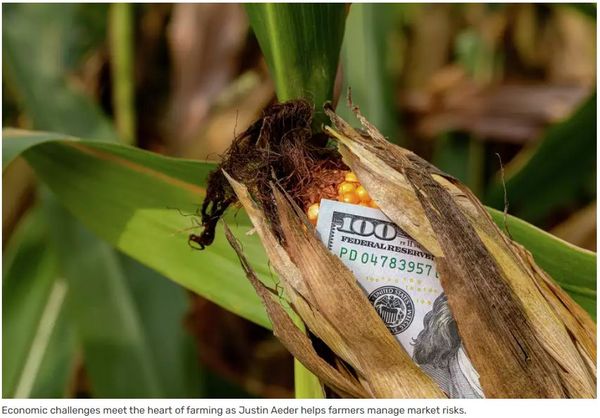
Economic challenges meet the heart of farming as Justin Aeder helps farmers manage market risks.
Justin Aeder, a Thumb area native, has worked in the agricultural industry for as long as he can remember. At just 13 years old, Aeder started working on a cash crop farm detasseling corn and has been involved in the Huron County farming community ever since.
Now, Aeder works as an Ag Management Risk Advisor for Advanced Trading Inc., helping farmers and agricultural businesses navigate the various risks that can affect their operations and profitability. Having witnessed the ever-changing dynamics of agriculture firsthand, Aeder has developed a deep understanding of the challenges farmers face, including the growing complexities tied to market uncertainty and external factors like tariffs.
"There's just so much uncertainty regarding the tariff situation, the weather in the U.S., the different ag policies, and it's really hard for these farmers because frankly their job is to produce a crop," Aeder said. "They love to challenge themselves to grow as big a crop as possible in the most cost-effective way possible. That's a full-time job that takes a lot of hours and a lot of their focus because so much for them now is different than it used to be."
For instance, farmers must acquire specialized certifications to handle certain chemicals and keep pace with ever-evolving tractor technologies, creating a relentless demand to stay updated and manage the complexities of modern farming.
"For them to be able to sit down and study the markets is becoming more and more challenging, and, generally speaking, the amount of uncertainty now compared to what it used to be 20 years ago has changed and increased a lot," Aeder said.
Aeder explained that marketing was once easier for farmers because commodities like corn, soybeans, and wheat didn't experience the significant fluctuations we see today.
"I think it has to do with the amount of information being shared worldwide compared to what it was 20 years ago," Aeder said. "In general, I think there are more fund managers and more dollars in the market now than 25 years ago. I think it just becomes increasingly challenging for them and for a farmer to try to keep track of everything on the production side and also stay on top of the markets. It's too much for one person."
To address this challenge, Ag Management Risk Advisors like Aeder assist farmers by monitoring the market on their behalf, enabling them to make the best possible financial decisions while managing their workload more effectively.
"Typically, I'm reading, watching, researching six to eight hours a day," Aeder said. "Farmers don't have time to do that, but if I can take that six-to-eight hours of research and summarize it in a five-minute conversation to them, that's worthwhile."
While Aeder dedicates much of his time to analyzing market trends and policies, he emphasizes the significance of staying informed, particularly when it comes to the ripple effects that international trade decisions, like tariffs, can have on local farmers and agricultural businesses.
"It was about mid-February when they started discussing tariffs being instituted, and, for whatever reason, the market started to react — the fund managers began to care — around that mid-to-late February timeframe. We saw the corn price drop significantly, almost 80 cents from the high to the low," Aeder recalled.
He explained that while some recovery has occurred in the past week and a half, driven by a USDA report and a 90-day pause on the tariffs announced by Trump, the market remains volatile.
"It is a constant ebb and flow dictated by the latest headlines about tariffs," Aeder said. "That is 100% what's driving the market."
Aeder also pointed to China's role as a major trading partner, noting the potential risks tariffs could pose.
"I would say probably the fact that China is our biggest soybean purchaser could have a significant impact on our area. They are also one of the largest beef importers from the U.S., so those would be two main challenges for our region," he explained. "But tariffs in general, whether they apply to the EU or any country in the world, could pose challenges. The U.S. is one of the largest grain exporters, and any type of tariff implications we face affect not just corn or wheat but the entire agricultural space."
Reflecting on past experiences, Aeder highlighted the tangible effects previous tariff policies had on local agricultural businesses, particularly those heavily reliant on overseas markets.
"I remember the last time we had Trump as president and entered into these tariff situations," he reflected. " I know we had some pretty significant dried bean processors in the area that sold a lot of their beans overseas, and they were affected by those tariffs. As a result, they lost some of the clients they would normally have shipped those beans to, or they were only able to do so on a smaller scale, which reduced their profit margins."
Building on that experience, Aeder expects a similar outcome this time, with the potential impact extending across the entire range of agricultural products.
He also expressed concerns about whether America will be able to maintain the necessary export rates and capacity to match the levels of agricultural production in the future if a trade agreement is not reached.
"We rely so much on exporting our agricultural goods, and if these tariffs jeopardize that in any way, it really puts pressure on our markets," Aeder explained. "If we can't sell to X, Y, and Z countries, we have to find a way to use that up, and right now in the U.S., we don't have the capabilities to do so. As a result, we will end up stockpiling more corn, soybeans, wheat, and dried beans, which will only further pressure the markets."
In the meantime, Aeder urges farmers and agricultural business owners to adopt a balanced strategy, given the significant market uncertainty. He recommends avoiding the extremes — neither selling too much of their crop in advance nor too little — since markets can shift dramatically in either direction with little notice.
Aeder emphasized the importance of staying informed, warning that ignoring market conditions is not a solution. He shared past examples where farmers, faced with unfavorable prices, chose to disregard the market and focus solely on producing the best crop they could. As a result, they often found themselves in the fall with poor prices, realizing they were either losing money or unable to turn a profit because they had been too afraid to take action.
"My advice to anybody is just stay involved," he said. "Stay in tune with what's happening with the market because this thing can get a lot worse than it is right now, and I don't want to see anyone lose their livelihood because they just ignored it."